
Custom Medical Pendant for an Algerian Hospital: British Standard Gas Outlets, 10 Sockets and a Network Port
A ceiling-mounted medical pendant customized for an Algerian hospital: British standard gas terminals, 2 O2, 2 vacuum, 2 air, 10 power sockets, 1 network port, 2 earthing terminals and an IV pole.
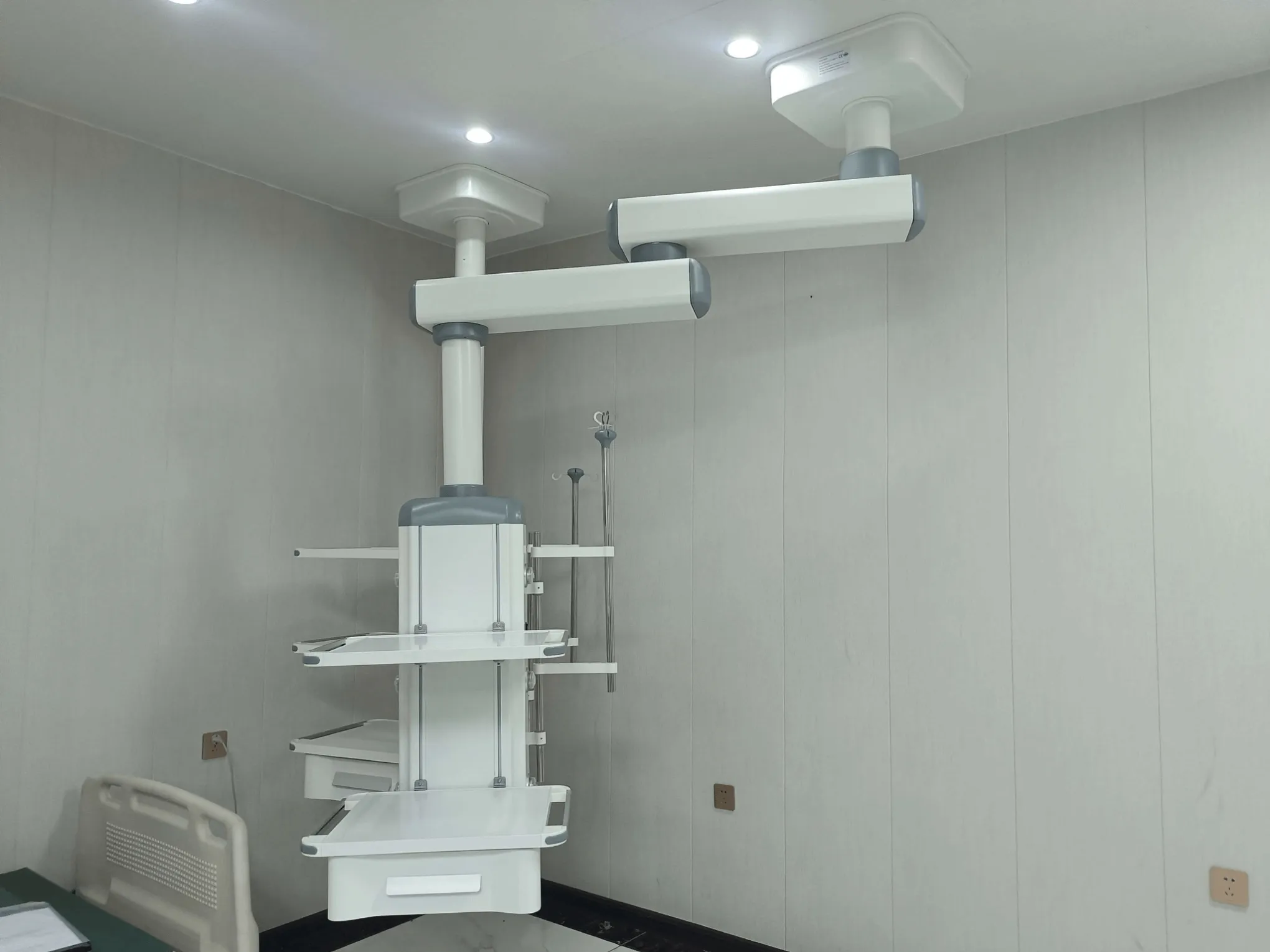
A ceiling-mounted medical pendant prepared for a hospital project in Algeria has been completed with a fully customized service configuration: six British standard gas terminals, ten multi-function power sockets, one network interface, two earthing terminals and one infusion pole.
The photographs in this article show the pendant after installation in the treatment room and a close-up of one of the oxygen outlets. Both are useful because they show the configuration as it was built rather than as a catalogue illustration: the rotating arm, the vertical service column, the shelving and every terminal on the service box were selected for one specific room and one specific equipment list.
The configuration delivered for this Algeria project
| Item | Delivered specification | Quantity |
|---|---|---|
| Medical gas terminals | British standard, single-gas, self-sealing quick-release Oxygen (O2) | 2 |
| Medical gas terminals | British standard Vacuum / surgical suction | 2 |
| Medical gas terminals | British standard Medical compressed air | 2 |
| Electrical outlets | Multi-function power sockets | 10 |
| Data connection | RJ45 network interface | 1 |
| Earthing | Grounding / equipotential bonding terminals | 2 |
| Accessory | Infusion (IV) pole | 1 |
| Mounting | Ceiling-mounted with rotating arm and vertical service column | 1 unit |
| Finish | White and light grey, smooth surfaces for routine cleaning | — |
The table is the specification that was agreed before production. It is not a standard catalogue model: another hospital in the same country could order a pendant with French terminals, different socket types, extra platforms or a second arm, and that would be an equally valid project.
Why this pendant was customized instead of ordered from stock
A medical pendant is a fixed part of the room's medical gas and electrical installation, so the deciding factors come from the hospital's engineering schedule rather than from a product brochure. In this project the customization covered five points.
1. British standard gas terminals
The gas terminal standard is normally fixed by what the hospital already uses. British standard outlets were specified for this project, so the pendant was built with British standard terminals rather than the French (AFNOR) or German (DIN) terminals more often seen in North Africa. This matters for three reasons:
- Hoses and probes – the anesthesia machine, ventilator and suction equipment must connect directly, without adapters.
- Consumables and spare parts – the biomedical department keeps one type of probe, one type of hose fitting and one type of service kit.
- Safety – adapters create extra joints, extra leak paths and a higher risk of connecting the wrong gas, so they should never be a permanent part of a clinical workflow.
Where a project has already installed a different standard, the pendant can be produced to match it; the important point is to confirm the standard in writing, together with a photo or drawing of the existing wall outlet.
2. Six gas terminals: 2 oxygen, 2 vacuum, 2 air
Two oxygen, two vacuum and two medical air terminals give the room working redundancy without over-building the service box. The layout is normally used as follows.
- Oxygen ×2 – anesthesia machine or ventilator inlet, plus a second point for a backup device, a transport ventilator check or a second breathing system.
- Vacuum ×2 – one point for surgical or procedure suction at the table, and one for anesthesia, specimen or ward suction.
- Medical air ×2 – air inlet for the anesthesia machine or ventilator, plus a point for a nebulizer, a pneumatic device or a second gas mixer.
Each terminal is gas-specific and cannot be connected to the wrong supply, and each one is engraved and colour-marked with the gas symbol and the gas name, so staff can identify it at a glance.
3. Ten multi-function power sockets
Ten sockets allow every device on the equipment list to stay connected at the same time, which is what actually saves time during a procedure. Multi-function sockets accept several plug types, which is practical when equipment is supplied by more than one manufacturer, and in Algeria the pendant itself is built for a 230 V / 50 Hz supply.
Before production, the sockets were allocated by zone and by device: anesthesia machine, patient monitor, electrosurgical unit, surgical light controls, infusion pumps, computer or imaging device, and so on. High-current equipment is best kept on its own circuit, and the hospital's electrical consultant should confirm socket type and circuit arrangement against local regulations, because universal sockets are not accepted in every country's electrical code.
4. One network interface and two earthing terminals
The single RJ45 port is intended for the device that needs data at the point of use: an anesthesia information system terminal, a PACS review screen, or a network connection for a monitor or camera. A separate earthing point is provided next to it, and two grounding terminals in total allow ancillary metal equipment on the pendant to be bonded to the room's equipotential system. The exact bonding arrangement should be agreed with the hospital's electrical engineer and included in the installation documents.
5. One infusion pole, shelves and accessory rails
The infusion pole supports IV lines at the height the staff actually work at, and the platforms and side rails carry the monitor, pumps and consumables. These details look minor on a quotation, but they decide whether the finished pendant is comfortable to use: a shelf that is too low forces staff to bend, and a rail in the wrong place leaves holders with nothing to attach to. Arm length, column travel and service box height were set from the room drawing and the ceiling structure of the installation site.
What the photographs show
The installed pendant
In the room photo, the pendant is fixed to the ceiling through a flange and mounting assembly, carried by a rotating arm with covered joints, and continues down through a vertical service column to the terminal box. Around the box are the adjustable platforms and the side rails for accessory holders, and the cabling is routed inside the structure so that nothing hangs loose above the working area. A second ceiling-mounted unit, visible at the top right of the photo, serves the other side of the room.
The oxygen terminal in close-up
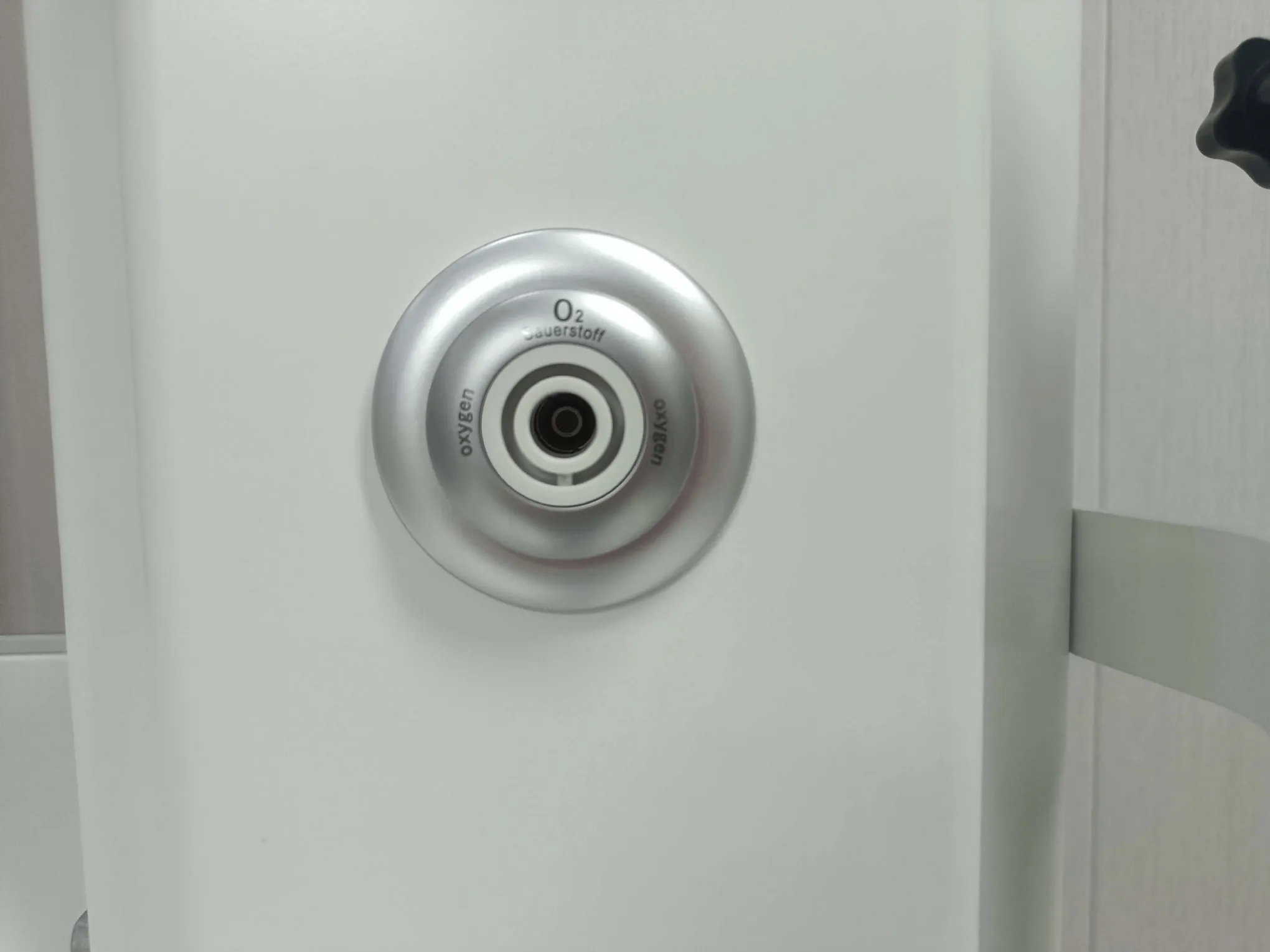
One of the two oxygen terminals on the pendant. The silver cover plate carries the gas symbol and the gas name in several languages, and the socket closes automatically when the probe is removed.
The close-up shows a single-gas quick-release socket set into the front panel of the terminal box. Three details are worth pointing out to a hospital's technical team:
- Marking – the cover plate is engraved with the O2 symbol and the gas name (oxygen, sauerstoff) so the terminal can be identified without a label that may fall off after cleaning.
- Self-sealing design – the valve closes when the probe is disconnected, so the outlet cannot leak into the room and the supply does not have to be shut down to change a device.
- Gas-specific indexing – the socket profile only accepts an oxygen probe, which is one of the strongest safeguards against connecting a device to the wrong gas.
Photographs like these are useful during a pre-shipment check: they show the number, type and position of the terminals, and they can be compared against the approved connection schedule.
Electrical, data and earthing checks before a pendant is approved
- Count every device that will be connected, and note its current draw and plug type.
- Split the sockets into wet-side and dry-side zones, and keep high-current equipment on a dedicated circuit.
- Confirm who supplies the network cable, and where it terminates in the room.
- Agree which metal parts require equipotential bonding and who verifies it after installation.
- Record the ceiling structure and height, because the mounting design must be approved by the site's structural or project engineer.
- Confirm that gas and electrical commissioning will be carried out by qualified local engineers, and that the system is tested before clinical use.
Visual inspection and photographs cannot replace commissioning records. Where a tender requires test reports, certificates or a specific acceptance procedure, those requirements should be written into the purchase contract and supplied before handover.
Documentation and support for Algerian hospital projects
Algerian hospital tenders and private hospital groups usually ask for more than a product photo. A custom pendant order can be supplied with dimensioned drawings, a technical datasheet, a packing list and the inspection documents requested in the enquiry, and OEM branding or localized documentation can be arranged when a distributor needs it. Installation guidance, online technical training and long-term spare parts support are part of the package, and our Algerian partner network can assist with local follow-up.
YIKUN Medical publishes four pendant layouts that can serve as a starting point for this kind of customization: the PLDT Single Arm Pendant, the PLQJ Single Arm Endoscopic Pendant, the PLEMT Electrical Anesthesia Pendant and the PLDQ Pendant Bridge. The gas terminals, sockets, data ports and accessories of any of them can be reconfigured to the project schedule.
Information to send with a pendant enquiry
- Room drawing or sketch, ceiling height and ceiling structure.
- Required gas standard, and the number of oxygen, vacuum, air or other terminals.
- Socket standard, voltage and required quantity.
- Number of data ports and the devices that will use them.
- Earthing requirement, and any accessories: infusion pole, shelves, drawers, monitor bracket, basket.
- Equipment list with weights, so that platform dimensions and load can be checked.
- Delivery site, target date and the documentation required for import and tender submission.
Contact YIKUN Medical
Muriel – Sales Manager, Nantong Yikun Medical
WhatsApp: +86 180 0148 1287
Email: muriel@nantongmedical.com
Website: www.nantongmedical.com.cn
Send the connection schedule and the room drawing, and the pendant configuration can be reviewed and quoted against the actual project instead of a stock model.