
Operating Table for C-Arm Imaging: What to Confirm Before Ordering
Planning an operating table for C-arm imaging? Compare three published YIKUN models, then confirm slide, tabletop and room-layout details before requesting a quote.
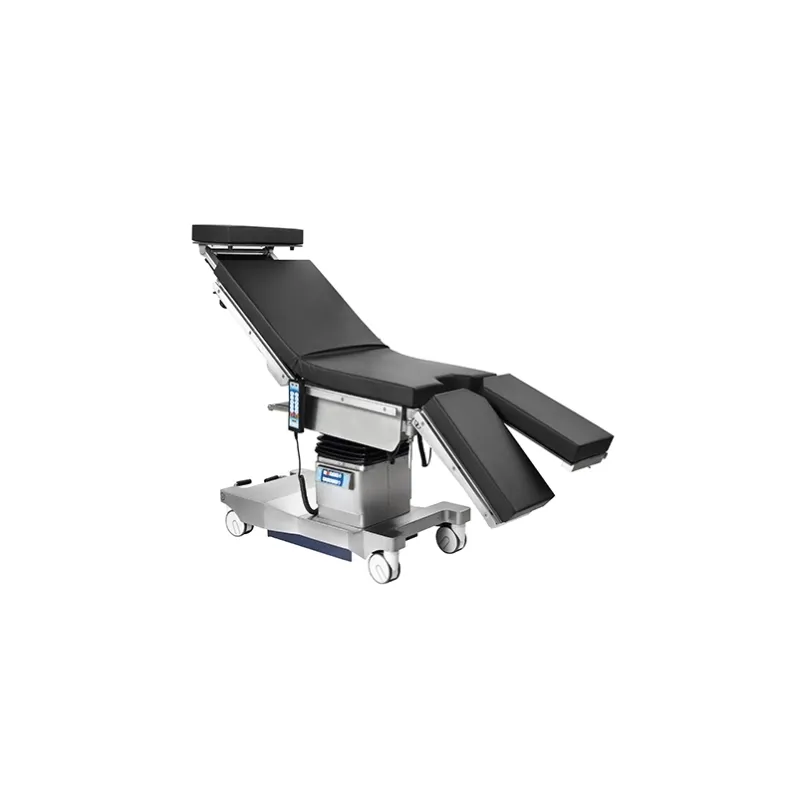
How do you choose an operating table for C-arm imaging? Begin with the intended imaging positions and the C-arm's route around the table, then check whether the quoted tabletop and slide configuration can accommodate them. A slide distance alone is not a guarantee of imaging access. YIKUN Medical publishes a 300 mm horizontal slide for its Electric Operating Table, a longitudinal slide of up to 345 mm for its Fully Electric Operating Table, and an X-ray-transparent tabletop for its Electro-Hydraulic Operating Table. These are separate models with different stated features.
This checklist helps a hospital buyer or distributor prepare a useful inquiry. It separates facts on the published pages from details that require model-specific confirmation.
Start with the imaging plan, not a slide number
Ask the clinical and technical teams to mark the planned patient positions and imaging regions on a room drawing. Show where the C-arm will enter, how it will move, and where its base and cables will sit. The operating table, ceiling light, pendant, monitors and other room equipment share the same space. The supplier needs this context to review clearance; a product listing cannot establish it for an individual operating room.
- Identify the C-arm manufacturer and model, including its dimensions or a technical drawing.
- Mark the planned table position, doorways, fixed equipment and available floor clearance.
- List which regions need imaging and the intended patient and tabletop positions.
- Show the desired C-arm approach direction and any ceiling-mounted equipment nearby.
- Specify the accessories that may be attached during imaging.
These details let the supplier discuss the actual configuration rather than rely on the broad phrase “C-arm compatible.” If the imaging workflow is still being defined, say so and request the model drawings needed for the clinical team to evaluate the options.
Compare the published table features accurately
The operating table category lists multiple products. For the specific question of imaging access, the website states:
| Model | Published imaging-related detail | Still to confirm |
|---|---|---|
| Electric Operating Table | 300 mm horizontal sliding and an X-ray/C-arm-compatible configuration | Actual slide direction in the room, usable imaging area and accessory effects |
| Fully Electric Operating Table | Longitudinal slide up to 345 mm for C-arm access | Travel and tabletop details for the exact offered configuration |
| Electro-Hydraulic Operating Table | X-ray-transparent tabletop for imaging applications | Radiolucent area and whether the quoted variant includes any slide |
The 300 mm and 345 mm figures are not interchangeable specifications, and a larger number does not automatically provide more useful image coverage. One page explicitly mentions tabletop transparency; another explicitly mentions C-arm compatibility. Neither statement tells you every imaging position available with your C-arm. Request a current datasheet, tabletop drawing and configuration-specific explanation before comparing bids.
Send the same project brief with every quote request
To compare costs fairly, ask each supplier to quote against the same requirements and identify optional items separately. Include:
- Imaging use: planned C-arm positions and imaging regions, marked on a sketch if possible.
- Room information: scaled layout, table orientation, fixed equipment and ceiling equipment.
- Equipment information: the C-arm model or drawing and any clearance limits.
- Table requirements: desired movements, tabletop sections, rails, mattress and positioning accessories.
- Site details: power supply, destination market, installation constraints and requested documentation.
Ask the supplier to state the exact table model, included components, options and any limitations that apply to your proposed setup. If a parameter is absent from the public product page, treat it as an open question rather than a standard feature. Written model-specific confirmation is especially valuable for radiolucent area, travel direction and imager clearance.
Frequently asked questions
Is 345 mm of slide always better than 300 mm?
No. The figures describe different models. Imaging access also depends on slide direction, tabletop construction, C-arm geometry and the views required. Compare model drawings against the same room plan.
Does “C-arm compatible” mean the whole tabletop is X-ray transparent?
Do not assume that. Request the radiolucent dimensions and any restrictions for the exact table and accessories offered.
What if a product page does not state a slide distance?
Ask whether the quoted configuration has a slide and request its direction and measured travel. Do not transfer another product's figure to it.
Can a published slide figure guarantee all planned images?
No. Ask the hospital's responsible clinical and technical teams to review the quoted table, C-arm and room drawings together before ordering.
What should I do next?
Review the operating table range, then send YIKUN Medical your room plan and C-arm requirements. Request a model-specific configuration and quotation that addresses the open questions above.